Most guides to this career start with what a fashion stylist does. If you are reading this, you already know. You want to know whether the route in is real, and three questions are probably stopping you. This guide answers those three first, then covers the rest.
| The three short answers Do you need a qualification? No. Styling is not a regulated profession in the UK and nobody can stop you working tomorrow. Training changes your access, your portfolio and your business ability, not your legal right to practise. Can you learn it online? Most of it, yes. Concept, colour, proportion, casting, sourcing, kit, call sheets and the business all teach perfectly well remotely. What does not is being on a live set with a photographer, a model and a deadline. The honest answer is that you learn the craft online and you need real shoots, and the two are separable. Do you have to assist for years? No, not any more. Assisting is still the most common route and still the best one for editorial and celebrity work. It is no longer the only one, and it is no longer a prerequisite for being published. |
Do you actually need a qualification?
Legally, no. There is no licence, no register and no protected title. The Fashion Retail Academy puts it plainly in its own careers guide: within styling, academic qualifications are not usually considered as important as creative and practical skills.
So the advice you keep reading, that you just need a good eye, is not wrong. It is incomplete. Here is what it leaves out.
A good eye is not evidence. Nobody books taste. They book a portfolio. The gap between people who can style and people who get paid to style is almost always a body of work that looks deliberate and consistent, and that is a production problem rather than a taste problem.
The industry runs on introductions. Photographers, models, hair and makeup artists, PR houses that lend samples. Self-taught stylists usually stall here, not on the styling. What a course is actually selling at this level is a room full of the people you need.
Nobody teaches you the business by accident. Rate cards, usage rights, kit fees, prep days, sample loan agreements, invoicing, chasing payment. These are the skills that decide whether you are still doing this in three years, and they are the ones self-taught stylists most often lack.
The correct way to read the advice, then: a qualification is not required, and a good course is not really selling the qualification. It is selling practice, access and the business, and you should judge any course you look at on those three things rather than on the certificate at the end.
What a client actually checks
It helps to know what happens after you send an enquiry, because it is not what most people preparing to retrain expect.
- A brand or e-commerce client looks at your portfolio, checks whether you have shot anything resembling their product, and asks whether you can work to a shot list and a schedule. Nobody asks where you studied.
- A photographer deciding whether to bring you onto a test looks at your last three stories and whether you are easy to work with. Reputation travels fast and in both directions.
- A magazine looks at the images and the concept. Submissions are judged blind of your training.
- A private client looks at reviews, before-and-afters, and whether your prices are clearly stated.
- An agency looks at the book, then at whether you already have paying clients. Representation follows traction rather than creating it.
Not one of those is a certificate check. That is why the honest case for training is never the certificate, and why a course that gives you shoots, introductions and a rate card is worth more than one that gives you a better-sounding qualification.
Can you learn fashion styling online?
This is the question with the most unhelpful answers online, usually because whoever is answering sells one format or the other. Split it in two and it becomes easy.
What teaches well remotely: concept development and mood boards, colour and proportion, garment knowledge, casting, sample sourcing and PR relationships, kit and toolkit, call sheets and shoot planning, image selection and editing direction, portfolio construction, and the entire business side. That is most of the job, and it is most of what a stylist does before and after a shoot day.
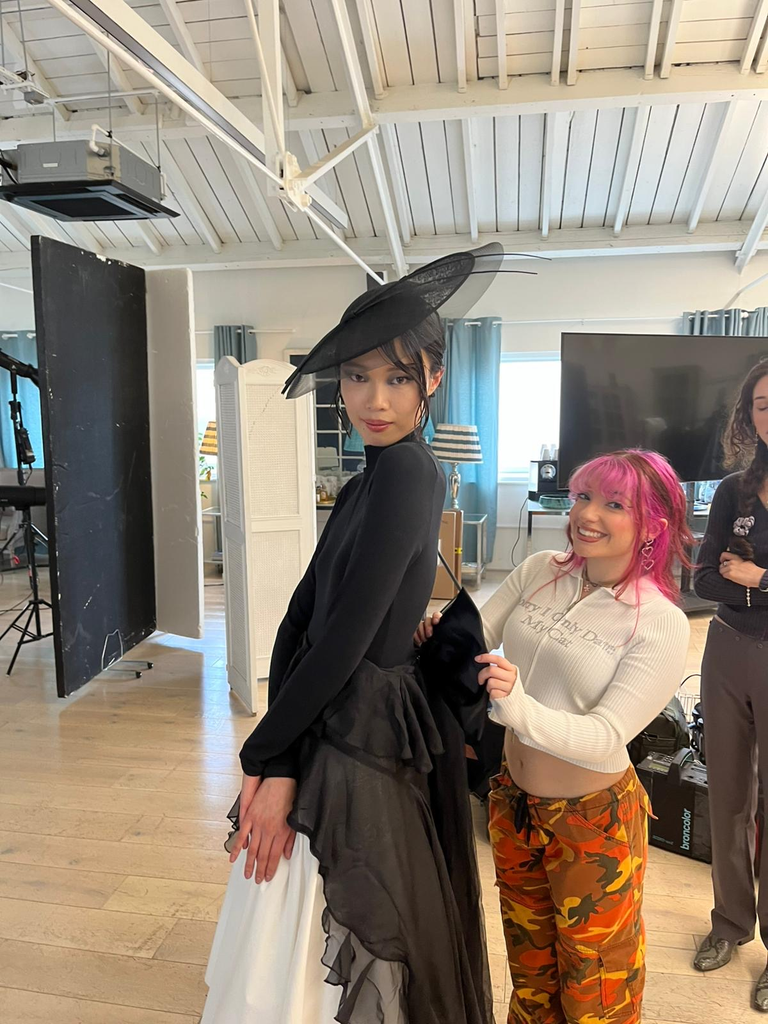
What does not teach remotely: standing on a live set while a photographer waits, a model is cold, the light is going and the sample does not fit. Steaming, pinning, taping and clamping under time pressure. Reading a room of people who all want something slightly different. Those are hours-on-set skills and no video will give them to you.
The practical conclusion: learn the craft in whatever format fits your life, then get on sets. The mistake is not choosing online. The mistake is choosing a course of any format that never puts you on a shoot, which is why the question to ask any provider is not “is it online?” but “how many real shoots will I do, with whom, and do I own the images?”
It is worth knowing this is not theoretical. Kenya Roper studied the Fashion Styling Diploma online with London College of Style and had an editorial, “Polarity of Self”, published in Dreamingless Magazine as her final assessment, roughly six months after enrolling, with four weeks of preparation and tutor guidance. She had styled three further editorials by the time the story was written. Online course, published editorial work, no relocation.
How to get on sets if your course does not provide them
If you are studying remotely and shoots are not built into the course, you have to manufacture them. This is ordinary and everybody does it at the start.
- Find photographers at your level rather than above it. A photographer two years in needs portfolio work as much as you do, and will say yes. Someone established will not.
- Use the collaboration platforms and local creative groups where photographers, models and hair and makeup artists post for test shoots. Offer a concept rather than availability. A stylist who arrives with a worked-out idea gets picked over one who offers to help.
- Approach model agencies for new faces. Agencies want test images for developing models and will often place someone on a shoot you have organised, which raises the standard of the whole day.
- Shoot small and finish. One completed six-image story beats three half-finished ambitious ones.
- Agree upfront who gets which images, what the credits are, and where each person may publish them. Almost every falling-out on a test shoot is about this and almost none of them need to happen.
Do you have to assist for years first?
Assisting is genuinely valuable and it is still the dominant route into editorial and celebrity work. On a good stylist’s team you learn the pace, the etiquette, the sourcing relationships and the failure modes faster than anywhere else.
Two things have changed.
The volume of paid work has shifted. Editorial is a small and badly paid corner of this industry. Most paid styling in the UK now is e-commerce, lookbook, social content, brand campaigns and private clients. Those clients hire on portfolio and reliability. Few of them care who you assisted.
Independent publishing is open. Smaller magazines accept submissions from stylists with no representation. A test shoot organised by you, with a photographer and model you cast, can be published on its own merits. That is the route Kenya Roper took, and it is available to anyone willing to organise a shoot.
The fair summary: assisting is the fastest way into high-end editorial and the slowest way into paid work. If your goal is a byline in a fashion magazine, assist. If your goal is to be earning from styling within a year, build a portfolio and go after commercial clients, and assist alongside it if you can.
If you do want to assist, how it actually happens
Assisting jobs are almost never advertised. They are filled from the stylist’s own contacts, or from a recommendation by someone already on the team.
- Identify ten stylists whose work you actually want to learn from, and follow what they shoot rather than who they are.
- Email them individually with a short note, a portfolio link and your availability. Not a round robin, and not a paragraph about your passion for fashion.
- Say what you can do on a set: steam, pin, run returns, keep a sample log, drive. Practical usefulness is the whole hiring criterion for a first assist.
- Be reachable and say yes at short notice. Most first assists happen because somebody dropped out.
- Agree the rate, the hours and the expenses in writing before the day. Unpaid assisting is common and widely criticised inside the industry; a refusal to put terms in writing tells you what the job will be like.
Once you are on a team, the relationships are the asset. The photographer, the hair and makeup artists and the PR contacts you meet assisting are the people who hire you or recommend you later.
The six jobs called fashion styling
These pay very differently and want different portfolios, so decide early which one you are aiming at. The Fashion Retail Academy splits the field roughly this way:
- Personal stylist: private clients, wardrobe edits and personal shopping. The most reliable income and the least glamour.
- E-commerce or digital stylist: high volume product shoots for retailers. The largest source of steady freelance work in the UK.
- Photoshoot or editorial stylist: magazines and campaigns. The most competitive and, at the editorial end, the worst paid relative to effort.
- Runway or fashion show stylist: seasonal, intense, largely built on relationships.
- Product stylist: still life and prop-led work for brands and catalogues.
- Film and TV stylist: costume-adjacent, its own union and hiring culture.
Most working UK stylists do two or three of these. A common and sensible combination is e-commerce and commercial work for income, editorial for profile, and private clients as a steady base underneath.
What fashion stylists earn in the UK
Read any figure on this subject with one thing in mind: nearly all of the public data measures employed stylist roles, mostly in-house and retail positions, rather than freelance shoot work. The one substantial survey of what freelance stylists actually charge, Stylist Elixir’s 2025 rate guide covering 1,223 stylists, sits behind a paywall.
| Source | Figure | What it measures |
|---|---|---|
| Fashion Retail Academy | 18,000 to 20,000 pounds junior; 23,000 to 30,000 pounds senior | In-house employed roles |
| Fashion Retail Academy | 50 to 150 pounds a day | Freelance, entry level |
| Glassdoor, London | 27,372 pounds average total pay | Employed roles, 50 self-reported submissions, Sept 2024 to July 2026 |
Treat the 50 to 150 pounds a day figure as the entry-level and assisting range: the floor you are working to leave, not the rate for a stylist running her own shoots.
How to price yourself
Since there is no public rate card worth copying, price from structure rather than from a number you found online.
- Charge a day rate, not an hourly rate. A styling day is a day regardless of how the schedule moves.
- Charge for prep separately. Sourcing, sample pulls, returns and travel are work. Half a prep day for every shoot day is a normal starting position.
- Charge a kit fee where you supply steamers, clamps, tape, backup sizes and shoes. It is standard and it is not included in your day rate.
- Price usage separately from labour on commercial jobs. A campaign running for two years across paid media is not the same job as a single social post, even if the shoot day is identical.
- Ask other stylists directly. Rates in this industry travel by conversation rather than by website, which is exactly why the public data is so thin.
Building a portfolio when nobody has hired you
This is the actual bottleneck, and it has a well-worn solution: test shoots. You organise a shoot with a photographer, a model, and hair and makeup, everybody works for the images rather than a fee, and everybody keeps the results.
What separates a portfolio that books work from a folder of test shoots:
- Consistency of point of view. Eight images that clearly come from the same stylist beat thirty that do not.
- A stated concept per story. If you cannot say in one sentence what a shoot was about, it will read as clothes on a person.
- Published placements. Even a small independent magazine changes how a portfolio is read, because someone other than you decided the work was good.
- Range that matches the job you want. If you want e-commerce work, a portfolio of dramatic editorial will not get it. Shoot what you want to be hired for.
Aim for three to five complete stories rather than a large number of single images, and be ruthless about cutting the weakest. A portfolio is judged on its worst image, not its best, because the worst one is the evidence of what happens on a bad day.
What one test shoot actually involves
If you have never run one, the shape of it is roughly this. It is a lot of logistics and comparatively little styling, which is itself the lesson.
- Concept first, in one sentence, with a reference board. Everything else follows from it and nobody joins a shoot with no idea attached.
- Assemble the team: photographer, model, hair and makeup. Confirm the date in writing with all of them.
- Source the clothes. Your own wardrobe, friends, vintage shops, small brands who will lend for a credit, and PR showrooms once you have published work to show them.
- Book the location. A studio if the budget exists, daylight and a clean wall if it does not.
- Prep: steam everything, pack backups a size either side, build your kit, write a shot list.
- Shoot day: dress, adjust, watch the frame rather than the rail, and keep the returns organised as you go.
- After: returns within the agreed window, select and direct the edit, then submit.
Do that five or six times and you have both a portfolio and a working method, which is most of what the first year of this career consists of.
Getting the first paid work
- Submit test shoots to independent magazines. Most publish submission guidelines. Rejection costs nothing.
- Approach small and mid-size brands directly with a portfolio aimed at what they actually shoot. E-commerce and lookbook work is where the recurring budgets are.
- Assist, if you can get it, for the relationships as much as the fee.
- Take private clients alongside. Wardrobe edits pay reliably while commercial work is still irregular, and the skills overlap more than people expect.
- Register with agencies and talent directories once your book is strong enough to represent you.
Two habits worth forming from the first paid job onwards, because they are what separate a styling business from a styling hobby.
Put it in writing. A short email confirming the fee, the prep days, the kit fee, the usage and who covers expenses is enough. It is not a contract negotiation and it prevents most of the disputes in this industry.
Keep a rate card and do not improvise. Deciding your price in the moment, in front of a client, is how stylists end up working a fourteen hour day for a flat fee with no expenses. Write the numbers down before anyone asks for them.
Where to train
Judge any course on the three things that actually matter: how much real shoot practice you get, what access and introductions come with it, and whether it teaches the business. The certificate is the least important part.
London College of Style trains stylists specifically for working practice rather than for an academic route, and runs two fashion styling options plus a crossover diploma.
| Course | Format | Length | Fee (inc. VAT) |
|---|---|---|---|
| Fashion Styling Advanced Diploma | Online, live and recorded masterclasses | 8 weeks | 915 pounds |
| Personal Styling Course London, Advanced Diploma | 1 week in London plus 6 weeks online mentoring | 7 weeks | 3,245 pounds |
| Fashion and Personal Styling Advanced Diploma | In person, Bloomsbury, 2.5 days a week | 6 weeks | 6,450 pounds |
The online Fashion Styling Advanced Diploma carries diploma certification accredited by the British Accreditation Council and a CPD certificate with 40 CPD points, and includes invitations to live editorial shoots and lifetime access to the LCS Agency. The in-person Fashion and Personal Styling Advanced Diploma carries an LCS Advanced Diploma Certificate accredited by A.C.E. and CPD certification worth 40 CPD training hours, and includes live projects and professional fashion shoots, hands-on workshops with real clients, a London Fashion Week experience, portfolio development and the Talent Directory. All fees can be paid in interest-free instalments.
Course pages, with full syllabus and start dates:
- Fashion Styling Advanced Diploma, online (915 pounds, 8 weeks)
- Personal Styling Course London, Advanced Diploma (3,245 pounds, 1 week in London plus mentoring)
- Fashion and Personal Styling Advanced Diploma, London (6,450 pounds, 6 weeks in person)
The other routes, honestly
University of the Arts London, through London College of Fashion and Central Saint Martins, runs short courses and a BA in Fashion Styling and Production. Strong name, strong creative teaching, and the academic route if that is what you want. The trade-off is less individual business support and, on the degree, three years and a degree-level fee.
Vogue College of Fashion runs fashion styling courses with the obvious brand advantage. The Fashion Retail Academy and similar colleges offer Level 3 and Level 4 qualifications in styling and visual communication, which suit school leavers and anyone who wants a recognised qualification framework.
There are also many short online certificates at a few hundred pounds. They can teach the fundamentals perfectly well. What they cannot give you is shoot practice, introductions or someone reviewing your portfolio, which are the parts that were going to be difficult anyway.
Common questions
Do I need a degree to be a fashion stylist?
No. There is no qualification requirement of any kind in the UK. A degree helps if you want to work in-house at a large organisation that filters applications by education, and matters very little for freelance client work.
Can I do this without moving to London?
Yes, with a caveat. Learning does not require London, and neither does e-commerce, brand or private client work, which happens everywhere there are brands and people. High-end editorial and celebrity work is concentrated in London, so if that is specifically your goal, plan to be there eventually.
How long before I am earning?
Realistically six to eighteen months from a standing start to consistent paid work, assuming you build a portfolio in parallel with learning rather than after it. Published editorial can come sooner; reliable income usually takes longer.
Is 36 too old to change career into this?
No. Styling rewards taste, organisation, client handling and reliability, all of which improve with age. A career changer with project management experience often converts to commercial styling faster than a graduate with a better eye.
What is the difference between a fashion stylist and a personal stylist?
A fashion stylist dresses a shoot, a show or a campaign, and the client is a brand or a publication. A personal stylist dresses a person, and the client is that person. The craft overlaps heavily and many UK stylists do both, which is why combined diplomas exist.
Do I need my own kit?
Eventually, yes, and you charge for it. Steamer, clamps, pins, tape, scissors, lint rollers, backup shoes and sizes. Build it up as you work rather than buying it all before your first job.
Will a course get me an agent?
No course guarantees representation, and be sceptical of any that implies it. What a good course can do is get your portfolio to a professional standard and put you in front of people who work in the industry, which is what agencies are actually looking at.
Is assisting paid?
It should be. Unpaid assisting is common and widely criticised within the industry. If you assist, agree the rate, the hours and expenses in writing beforehand, and treat a refusal to do that as information about the person you are about to work for.
Sources
Salary and rate data: Fashion Retail Academy, Fashion Careers: Guide to Stylists; Prospects stylist job profile (July 2025); Glassdoor UK, fashion stylist salaries in London (50 self-reported submissions dated September 2024 to July 2026); Stylist Elixir, The 2025 Fashion Styling Rate Guide, noted as covering 1,223 stylists, full figures behind a paywall.
Student outcome: London College of Style, Kenya Roper, Fashion Styling Online Diploma, editorial “Polarity of Self” published in Dreamingless Magazine.
Course fees, formats and accreditations: London College of Style course pages, retrieved September 2026. Fees are inclusive of VAT and correct at the time of writing. Check the course page for current pricing and start dates.