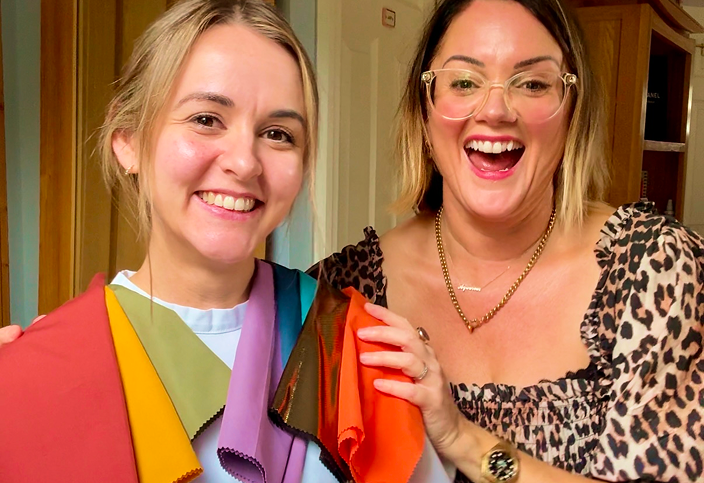
Yes, and the honest version of that answer has conditions attached.
You can learn to drape properly through an online course, provided three things are true: you have real drapes in your hands rather than images on a screen, you are taught live by someone who can correct you in the moment, and you are assessed on real people rather than on a quiz. Take any of those three away and the scepticism is justified.
This piece explains what draping actually demands, where online training genuinely struggles, and what to check before you enrol anywhere.
First, two different questions get mixed up
Search for this and most of what comes back answers a different question.
Question one: can a client be analysed accurately online? That is about receiving a consultation by video or by submitting photographs. It is a real debate, it turns on lighting and camera behaviour, and most published articles on the subject are about this.
Question two: can you learn to do colour analysis online? That is about training. It turns on whether a course can teach a physical skill remotely and assess whether you have acquired it.
They are not the same question and the answers differ. A nervous prospective student reads an article about blurry client selfies and concludes that online training cannot work. The two problems are unrelated. When you train, you are not analysing someone through a camera. You are standing next to a real person with real fabric in your hands, and your tutor is watching you do it.
What draping actually requires
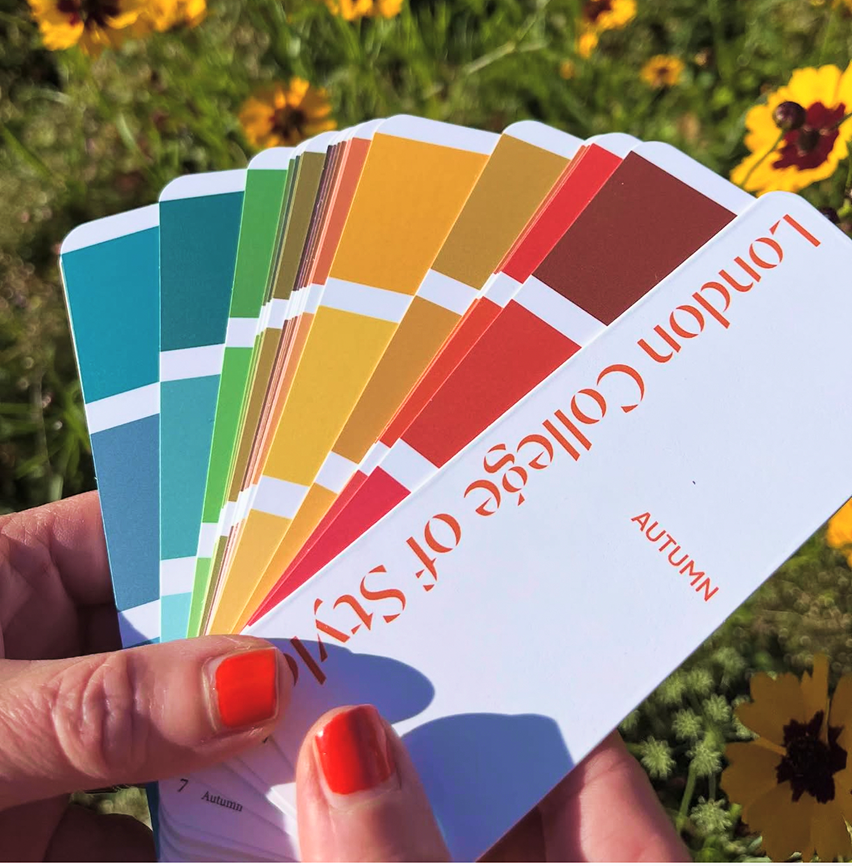
Colour analysis is not a colour theory exam. The judgement you are learning to make is whether a particular fabric, held under a particular chin, makes the skin settle or makes it struggle. It is a perceptual skill, and it comes from repetition.
Four things have to happen for that skill to develop.
- You handle physical drapes. Colour on a screen is not colour on fabric. Screens emit light, fabric reflects it, and the difference is exactly what you are being trained to read.
- You see the same face under different colours, repeatedly. The learning happens in the comparison, not in any single drape.
- Someone more experienced tells you what you missed. Early on you will see a reaction that is not there, or miss one that is. Without correction you will practise the mistake.
- You work on people who are not your friends. Real clients have makeup, dyed hair, tans and strong opinions. Case studies on varied subjects are where the theory stops being theory.
None of those four require you and the tutor to be in the same room. All four require that you are not simply watching videos.
Where online training genuinely struggles
Being straight about this matters more than reassurance, because these are the situations where scepticism is correct.
Recorded-only courses. If the entire course is pre-recorded video and a downloadable manual, nobody ever watches you drape. You will finish with knowledge and no calibration, and you will not know which of the two you are missing.
Courses with no physical kit. Some online courses expect you to buy drapes separately or to work from printed swatches. Printed colour and dyed fabric behave differently, and a partial kit teaches partial judgement.
Assessment by multiple choice. A written test proves you learned the seasons. It proves nothing about whether you can run a session.
Your own screen, when you are the one being taught. If a tutor demonstrates a drape on camera, what you see has passed through their camera’s white balance and your monitor’s calibration. Demonstrations are useful for method and sequence. They are not where you learn to judge a reaction. That has to happen with fabric in your hands.
That last point is the real limitation of online delivery, and it is also the reason a course should send you a kit rather than expect you to learn by watching.
What makes online colour analysis training work
The courses that teach this successfully online share the same structure.
| What to look for | Why it matters |
|---|---|
| A full professional drape set, posted to you | You cannot learn a fabric-based skill without fabric. A full set means enough drapes to compare within a season, not just between seasons. |
| Live teaching on a timetable | Someone has to see you work and correct you while you are still doing it. Recordings are for catching up, not for learning the skill. |
| Assessed case studies on real people | The qualification should rest on sessions you actually ran, not on a test you sat. |
| Explicit instruction on lighting and set-up | How you light a session changes what you see. This is taught, not obvious. |
| Training in both in-person and remote consultations | Most working analysts now do both. If a course only covers one, you are limited to one. |
| Named accreditation you can verify | Ask which body, and check it exists independently of the provider. |
How the London College of Style teaches it
The Colour Analysis Course Online: Advanced Diploma is built around the four conditions above, so it is a useful worked example of what online delivery should look like.
A professional kit arrives before the course starts. Four luxury seasonal colour fans of around 100 shades each, more than 40 professional drapes, a white draping bib, a colour wheel and a kit bag. That is the part that answers the scepticism directly. You are not learning draping by looking at a screen, you are learning it with the same equipment you will use on paying clients.
Teaching is live, weekly, on a fixed timetable. Masterclasses run every Wednesday at 10:30 GMT across nine weeks, with recordings available if you have to miss one. Expect to give it three to four hours a week, plus time for your client case studies.
You are assessed on real sessions. Client case studies are part of the course rather than an optional extra, which is what turns the theory into a skill you can charge for.
Both delivery modes are covered. The course teaches in-person and online draping, so you can work with clients in your area and with clients in another country.
The method is named and the progression is clear. You train in the Four Seasons method, with colour psychology, secondary influences and an introduction to the 12-sub-season system, and there is a separate Sub-Season Masterclass afterwards if you want to specialise further.
Accreditation is named. An Advanced Diploma accredited through A.C.E., Accreditation for Creative Excellence, plus CPD certification for 40 hours.
The fee is published. £1,530 including VAT, payable in full or in three interest-free instalments of £510, with the kit included. Several providers in this category will not quote a price without an enquiry form, which makes comparison harder than it needs to be.
So should you train online or in person?
Choose in-person training if you learn best with someone physically beside you, you want the training compressed into a few consecutive days, and travel and accommodation are not an obstacle.
Choose online training if you are fitting study around work or family, you want the learning spread over weeks so that practice has time to bed in, or the courses you rate are not within reach of where you live. Spreading a course over nine weeks is not a compromise in this subject. Perceptual skill improves with repetition over time, and a course that gives you eight weeks of practice between the first drape and the last assessment is doing something a two-day intensive cannot.
What should not decide it is a vague worry that online cannot work. Ask the specific questions instead.
Five questions to ask before you enrol
Ask by email, so you have the answers in writing.
- Is a full drape set included in the fee, and how many drapes and fans does it contain?
- How many hours of live teaching are there, and is the tutor watching me practise or only presenting?
- How am I assessed, and does that assessment involve real clients?
- Does the course teach remote consultations as well as in-person ones?
- Which body accredits this, and can I verify it independently of you?
Frequently asked questions
Can you learn draping properly over Zoom?
You can learn it on a course delivered over Zoom, provided you have a physical drape set in your hands and live tutor feedback on your technique. You are not draping through the screen. You are draping real people in your own space while a tutor observes and corrects you. What Zoom cannot do is teach you to judge a colour reaction from a video feed, which is why a course should send you fabric rather than expect you to learn from watching.
Is an online colour analysis qualification taken as seriously as an in-person one?
Clients almost never ask where you trained. They ask whether you are qualified and whether your work is good. What matters to credibility is the accrediting body, the depth of assessment and your portfolio of completed consultations, none of which depend on whether the teaching happened in a room or on a call.
Do I need to buy my own drapes?
On some courses, yes, and it is worth checking early because a professional set is a significant cost on top of the fee. On others the kit is included and posted to you before teaching begins. The London College of Style course includes four seasonal colour fans, more than 40 drapes, a draping bib, a colour wheel and a kit bag in the £1,530 fee.
How long does it take to train as a colour analyst?
Courses range from a single intensive day to several months. Short courses can cover the theory quickly. The judgement takes practice regardless of format, so a course spread over weeks gives that practice somewhere to happen. The London College of Style diploma runs over nine weeks at three to four hours a week plus case study time.
What colour analysis system should I train in?
The Four Seasons method is the most widely used foundation and the one most clients recognise. Tonal and 12-season systems build on it rather than replacing it. Training in a seasonal foundation first and specialising later is the usual route, and it keeps your options open.
Can I offer online colour analysis consultations to clients once I qualify?
Yes, and many working analysts do, which is how they take clients in other countries. It requires specific technique around lighting, photograph briefing and how you present results, so check that your course teaches remote consultations explicitly rather than assuming the in-person method transfers.
Do I need a background in fashion or beauty to start?
No. Colour analysis is taught from first principles on most accredited courses, and career changers are common in this field. Experience in any client-facing role transfers more usefully than you would expect.
How much can I charge for a colour analysis consultation?
Rates vary widely by location, by whether the session is standalone or bundled with styling, and by how established you are. Look at what analysts in your own area publish, and note that adding colour analysis to an existing styling practice is usually easier to price than starting cold.
Where to go next
If you want to see how an online colour analysis diploma is structured in practice, the Colour Analysis Course Online: Advanced Diploma page sets out the modules, the kit, the dates and the fee in full. You can also browse the other colour analysis course options, or the personal styling courses if you are looking to build colour analysis into a wider styling practice. Everything is listed together under all courses.